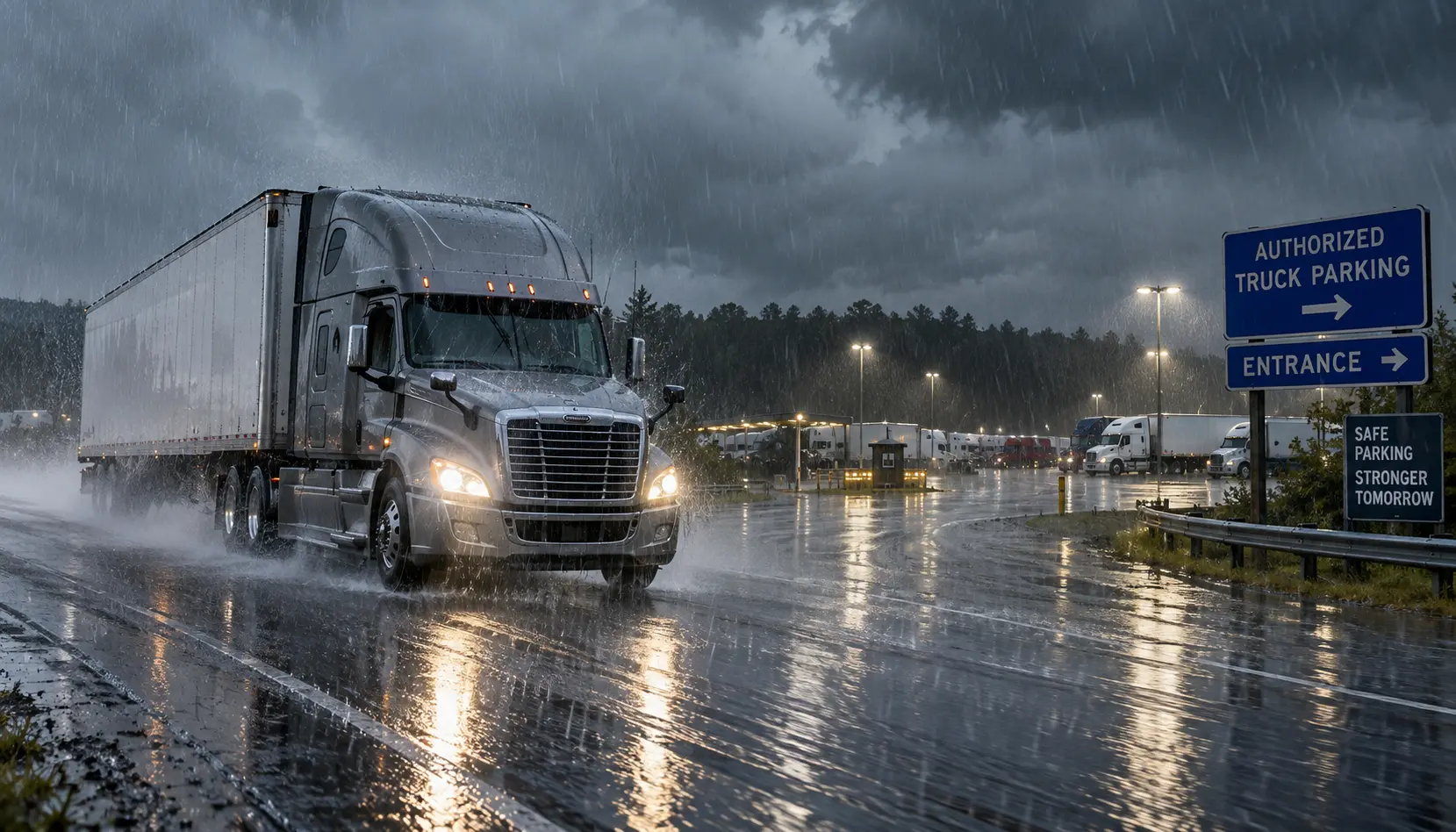
The forecast said light rain. An hour later, the lane markings are difficult to see, water is collecting near the shoulder and every vehicle ahead is throwing spray across your windshield.
Your appointment has not changed. The road has.
When weather begins to affect visibility, traction, steering or the amount of space needed to stop, reduce your speed and increase your following distance. If you can no longer maintain control or see far enough ahead to respond safely, leave the road at the nearest safe and authorized location.
Finishing the trip is never more important than remaining in control of the truck.
How much does bad weather affect large-truck crashes?
The Federal Motor Carrier Safety Administration cites two figures that show why speed and weather must be considered together:
- The Large Truck Crash Causation Study reported that 23% of large-truck crashes occurred when commercial drivers were traveling too fast for conditions.
- Fatality Analysis Reporting System data cited by FMCSA found that 25% of speeding-related large-truck fatalities occurred during adverse weather conditions.
These percentages come from federal studies referenced in FMCSA’s commercial driving guidance. They do not mean weather caused every crash. They show that maintaining a speed that is too high for the actual road conditions is a recurring factor.
Source: FMCSA — Driving Too Fast for Conditions.
What does federal regulation require?
Under 49 CFR §392.14, commercial drivers must use extreme caution when hazardous conditions affect visibility or traction. The regulation covers conditions such as snow, ice, sleet, fog, mist, rain, dust and smoke.
The driver must reduce speed when those conditions require it. If conditions become sufficiently dangerous, commercial vehicle operation must be discontinued and cannot resume until the truck can be operated safely.
There is an important exception. If stopping immediately would create a greater danger to the driver, passengers or other road users, the driver may continue only until reaching the nearest place where that danger can be reduced.
The rule is summarized in the FMCSA Motor Carrier Safety Planner.
A delivery schedule, available ELD time or pressure from traffic does not change the driver’s responsibility to respond to the road in front of the truck.
How do you know when conditions are becoming unsafe?
There is no single speed, rainfall amount or wind reading that applies to every commercial vehicle.
A loaded tractor-trailer, an empty trailer and a bobtail can respond differently to the same gust. Road design, tire condition, traffic, visibility and driver experience also affect the decision.
Watch what the truck and the road are telling you.
| Condition | Warning signs | Reasonable response |
| Heavy rain | Lane markings disappear, standing water develops or visibility drops | Reduce speed, increase following distance and stop if visibility or control continues to deteriorate |
| Strong wind | The trailer moves within the lane or steering requires constant correction | Reduce speed and look for authorized parking away from exposed roadway sections |
| Fog or smoke | Vehicles or signs appear with little warning | Reduce speed, use appropriate lights and leave the roadway if you cannot see far enough ahead |
| Snow or ice | Steering feels light, braking response changes or other vehicles begin sliding | Avoid sudden movements, reduce speed well before curves and stop when traction becomes unreliable |
| Flooding | Water crosses the roadway, barriers are in place or the road surface cannot be seen | Do not enter the water; turn around and use an authorized alternate route |
| Severe storm warning | Alerts indicate damaging wind, hail, tornadoes or flash flooding along the route | Contact dispatch and identify a safe stopping location before the storm reaches the truck |
Do not wait for a loss of control to confirm that the conditions are dangerous.
How much should a truck slow down in rain or snow?
FMCSA training guidance recommends reducing normal speed by approximately:
- One-third on a wet road.
- One-half or more on a snow-packed road.
Using the agency’s example, a truck traveling at 60 mph under dry conditions would reduce to approximately 40 mph on a wet road and 30 mph on a snow-packed road.
These figures are general guidance, not a guaranteed safe speed. Heavy rain, ice, poor visibility, wind, traffic or worn pavement may require a greater reduction or a complete stop.
The posted speed limit describes the maximum legal speed under appropriate conditions. It does not promise that the same speed remains suitable during a storm.
Why the beginning of a storm can be especially difficult
The first minutes of rainfall can make a road unexpectedly slippery because water mixes with oil and other materials already on the pavement.
Drivers may also need more time to recognize how quickly conditions are changing. Light rain can become heavy enough to hide lane markings, while water that appears shallow can cover damaged pavement or a washed-out section of road.
Slow down before the truck begins to slide. Hard braking after traction has already been lost leaves fewer options.
FMCSA also advises drivers to approach curves and exit ramps below the speed they might use in a passenger vehicle. A truck’s height, weight and load distribution change how it responds through a curve, especially when the road is wet.
Never guess how deep flood water is
Flood water is difficult to judge from inside a cab. The pavement may have collapsed, the current may be stronger than it appears and the water level can rise quickly.
According to the National Weather Service, more than half of flood-related drownings happen when a vehicle is driven into hazardous flood water. The agency also warns that two feet of rushing water can carry away SUVs and trucks.
Never drive around a barrier blocking a flooded road. Turn around and use an authorized alternate route.
Source: National Weather Service — Turn Around, Don’t Drown.
If the alternate route would place the truck on a restricted road, bridge or residential street, stop and verify the route before continuing.
High winds require more than watching the forecast
A weather app may show an average wind speed, but the truck responds to individual gusts.
Risk can change according to:
- Whether the trailer is loaded or empty.
- The height and profile of the trailer.
- Wind direction.
- The weight and distribution of the load.
- Exposed bridges or elevated roadways.
- Open areas without protection from surrounding terrain.
- Sudden changes when passing buildings, hills or other trucks.
An empty trailer may require a different decision than a fully loaded one. There is no universal wind speed that guarantees safe operation for every combination.
If gusts are moving the trailer across the lane or requiring continuous steering corrections, begin looking for a place to stop. Do not depend on a highway shoulder or entrance ramp as a waiting area.
Fog changes how much road you have available
The problem with fog is not limited to seeing fewer vehicles. It also reduces the distance available to recognize stopped traffic, debris, work zones or a closed lane.
When driving in fog:
- Reduce speed gradually.
- Increase the space ahead.
- Use low-beam headlights when appropriate.
- Avoid following another vehicle’s lights too closely.
- Do not make sudden lane changes.
- Leave the roadway when visibility is no longer sufficient.
Stopping in an active lane is extremely dangerous. If you need to stop, continue cautiously to an exit, rest area or authorized commercial parking location whenever that can be done safely.
Check the weather beyond your current location
Clear skies at the beginning of a trip say little about the conditions two or three hours ahead.
Before leaving, check:
- The National Weather Service forecast along the full route.
- Severe weather watches and warnings.
- State 511 systems for closures, incidents and road conditions.
- Mountain passes, bridges or open corridors exposed to wind.
- Low-lying areas with a history of flooding.
- Authorized parking before and after the expected weather zone.
Review the route again during a scheduled stop. Do not handle a phone or weather application while driving.
If a warning has already been issued, identify where you can stop before entering the affected area. Parking options may fill quickly when several drivers make the same decision.
Inspect the truck with the weather in mind
A normal pre-trip inspection becomes more important when poor weather is expected.
Pay particular attention to:
- Tires and visible tread condition.
- Windshield wipers and washer fluid.
- Headlights, brake lights and markers.
- Mirrors and windows.
- Brakes and air pressure.
- Trailer connections.
- Cargo securement.
- Defroster and climate controls.
- Emergency warning equipment.
A small problem on a dry afternoon can become a much larger one when visibility and traction are already reduced.
Do not begin a route expecting the weather to compensate for equipment that is not functioning correctly.
Can the adverse-driving-conditions exception add more time?
FMCSA’s hours-of-service regulations include an adverse-driving-conditions exception. When the conditions qualify, a property-carrying driver may extend the 11-hour driving limit and the 14-hour driving window by up to two hours.
The exception is not an automatic extension for every rainy or congested trip. It generally addresses conditions that could not reasonably have been known before the driving period or trip began.
More importantly, the exception does not require a driver to continue when conditions are unsafe.
Before using it:
- Confirm that the situation meets the federal definition.
- Notify dispatch or the carrier.
- Record the event according to company procedures.
- Check what the ELD requires.
- Stop if the truck cannot be operated safely.
Review the current requirements on the FMCSA hours-of-service summary.
Make the stopping decision before it becomes urgent
Bad weather creates two problems at the same time: the road becomes harder to manage, and nearby parking begins to fill.
A practical weather plan should include:
- A preferred authorized parking location before the affected area.
- A backup along the same route.
- Phone numbers for checking availability.
- Confirmation that the facility accepts your equipment.
- Enough driving time to reach the location before conditions worsen.
- A way to notify dispatch, the receiver or the customer.
Call the parking facility before leaving the planned route. Ask whether it can accommodate a bobtail, stand-alone trailer or full tractor-trailer combination and whether access will remain available during the storm.
Do not assume a retail lot, vacant property or industrial street allows commercial parking simply because other trucks are present.
What should you do after parking?
Once the truck is in an authorized space:
- Tell dispatch where you stopped.
- Confirm that the truck and trailer are completely inside the assigned space.
- Check local warnings and road closures.
- Avoid parking where the truck blocks emergency access.
- Keep required lights or warning devices available.
- Wait for official information before returning to the route.
- Inspect the truck again if the storm involved wind, hail, flooding, snow or falling debris.
A weather warning ending does not mean every road is immediately open. Flooding, ice, fallen trees and crashes may continue affecting the route after the rain or snow has stopped.
Planning for severe weather near Atlanta
Drivers traveling through Georgia can monitor road incidents, closures and cameras through 511 Georgia. Forecasts and local weather warnings for Metro Atlanta are available from the National Weather Service in Peachtree City.
If your route brings you toward Atlanta and conditions are getting worse, ATL Truck Parking accommodates:
- Bobtails.
- Stand-alone trailers.
- Tractor-trailer combinations.
- Daily parking.
- Extended and monthly parking.
The facility offers 24/7 access, camera monitoring and commercial truck repair services at the same location.
Availability can change during major traffic or weather events. Call 470-725-8283 before leaving your route to confirm that an appropriate space is available and receive arrival instructions.
View daily truck parking information.
Watch the road, not only the clock. When conditions change, the plan should change with them.
Frequently asked questions
When should a truck driver stop because of bad weather?
Stop when visibility, traction, wind or road conditions no longer allow the truck to be controlled safely. Federal regulation requires commercial drivers to discontinue operation when hazardous conditions become sufficiently dangerous.
Is the posted speed limit safe during heavy rain?
Not necessarily. The posted limit may be too fast for current visibility, traffic or traction. Drivers must adjust their speed to the actual conditions.
How much should a truck slow down on a wet road?
FMCSA training guidance recommends reducing normal speed by approximately one-third on wet roads. More severe conditions may require a greater reduction or stopping completely.
Can a truck drive through flood water?
Drivers should never enter flood water when the depth, current or roadway condition cannot be confirmed. The National Weather Service advises all motorists to turn around rather than drive through a flooded road.
Is an empty trailer safer during high winds?
Not automatically. An empty or lightly loaded trailer may respond differently to strong crosswinds and gusts. Trailer type, road exposure, wind direction and vehicle configuration all affect the risk.
Can a driver use the adverse-weather exception to reach parking?
The adverse-driving-conditions exception may provide up to two additional hours when all federal requirements are met. It is not automatic and does not permit a driver to continue operating an unsafe vehicle in dangerous conditions.
Can I wait on a highway ramp until the storm passes?
Highway shoulders and ramps should not be treated as routine truck parking. Use an authorized facility, rest area or another location that expressly permits commercial vehicle parking.
This article provides general safety and route-planning information. It does not replace federal or state regulations, official weather warnings, an ELD, legal advice or a carrier’s safety procedures. Weather, road conditions, facility policies and parking availability can change quickly. Follow posted signs and instructions from transportation, emergency and law-enforcement authorities.